Managed Wi-Fi for Multifamily Developers | Skyrise Wi-Fi
Solutions Managed Wi-Fi Smart Building Who It's For Owners and Investors Operators and Asset Managers Developers Case Studies Learn How It Works Company About Use the NOI Calculator Request Property Assessment
01 Pre-Construction Planning
02 Design and Rough-In
03 Commissioning
04 Handoff and Operations

Managed Wi-Fi for Multifamily Developers

Build the Infrastructure
the Asset Demands.

Internet is a building system. Design it that way from the start and deliver ownership an asset that generates revenue on day one, not a fragmented ISP problem to solve after turnover.

Class A and market-rate multifamily. New construction and gut rehab. 100+ units. 48 US states.

How the System Works
Access Points in Every Unit
One device per unit, placed during construction. No visible equipment for residents.
Planned Around Your Building
Cabling and closet requirements defined at design phase and added to your drawings.
Monitored Remotely
Skyrise Wi-Fi manages and monitors the network continuously. No on-site IT staff needed.
Ownership Receives a Revenue Asset
Property owns the system outright. Internet revenue starts from the first lease.
Phase 01
Planning and Design

Skyrise Wi-Fi reviews your plans and works with your team to position the network before permits are filed. No guesswork after construction starts.

Pre-Permit
Phase 02
Construction Coordination

We stay active through the build. Cabling, closet builds, and equipment locations are verified before walls close in. No surprises at activation.

During Construction
Phase 03
System Activation

Equipment installed, network configured, full-building coverage tested and confirmed. The system is live before certificate of occupancy.

Pre-CO
Phase 04
Handoff to Ownership

Ownership receives a fully operational network with an active internet revenue line from the first lease. Skyrise Wi-Fi stays on as the long-term operating partner.

Turnover
The Infrastructure Gap

Every building system is designed
with intent. Internet rarely is.

Electrical, plumbing, HVAC, and access control are each planned, specified, and coordinated before a shovel breaks ground. Internet infrastructure is typically left to individual residents and outside providers after move-in.

That gap in design discipline has direct financial consequences. Ownership inherits a building where every resident is paying $60 to $90 per month for internet to an outside provider — a recurring revenue stream the asset never participates in, and a building system that was never designed at all.

Model the NOI impact for your project
01
No Internet Revenue at Handoff
Ownership receives a building where every resident will pay $60 to $90 per month for internet to an outside provider. None of that flows to the asset. It never did.
02
Fragmented Infrastructure, No Accountability
Multiple providers, conflicting equipment, uncoordinated closet usage, and no single accountable party for connectivity from day one of operations.
03
Retrofitting Costs More Than Building It In
When ownership decides to address internet quality post-construction, the building has to be worked around. Costs increase significantly. Disruption to residents is unavoidable.
04
Nothing to Capitalize at Disposition
A building with no internet revenue line has nothing to underwrite at sale. A property-owned system generating $52 per unit in net NOI is a capitalized asset. Without it, that value does not exist on the balance sheet.
How Skyrise Wi-Fi Integrates

Designed Into the Build, Not Bolted On After

Skyrise Wi-Fi enters the project at design phase and coordinates directly with your team through construction, commissioning, and handoff. No floor plan changes. No schedule impact. No unfamiliar subcontractors. The requirements are consistent with how Class A buildings are already built.

Phase 01 — Design

Network Planned Before You Break Ground

We review your building plans before permits are filed. Equipment locations, cabling routes, and closet requirements are documented and handed off to your team so the network is built in — not retrofitted later.

Plan review with your architect or engineer
Equipment location documentation
Closet sizing and power requirements
Cabling layout for your electrical team
Phase 02 — Construction

Active Through the Build

Skyrise Wi-Fi stays involved during construction. We coordinate with your general contractor to verify that cabling and closet builds are on track before walls close in, so there are no surprises when it is time to activate the system.

General contractor coordination
Cabling and closet verification
Progress check-ins during key milestones
Scope questions answered through construction
Phase 03 — Activation

Live Before Move-In

Equipment is installed, the network is configured, and full-building coverage is tested before the certificate of occupancy. When the first resident moves in, the internet is already working.

Equipment installation and configuration
Internet connection established and tested
Full-building coverage verified
Operational handoff documentation
Ready to Add It to Your Project?

We review plans at any stage — design, permit, or under construction.

Schedule a Pre-Construction Consultation
What the Building Needs

Managed Wi-Fi Rough-In Requirements for Multifamily Construction

Skyrise Wi-Fi provides a clear documentation package at design phase that covers everything your electrical team needs to build the network into the project. The requirements are consistent with how Class A multifamily buildings are already wired.

No specialized subcontractors. No unfamiliar systems. We are available to walk through the requirements with your architect or engineer at any stage.

Request your project's requirements document
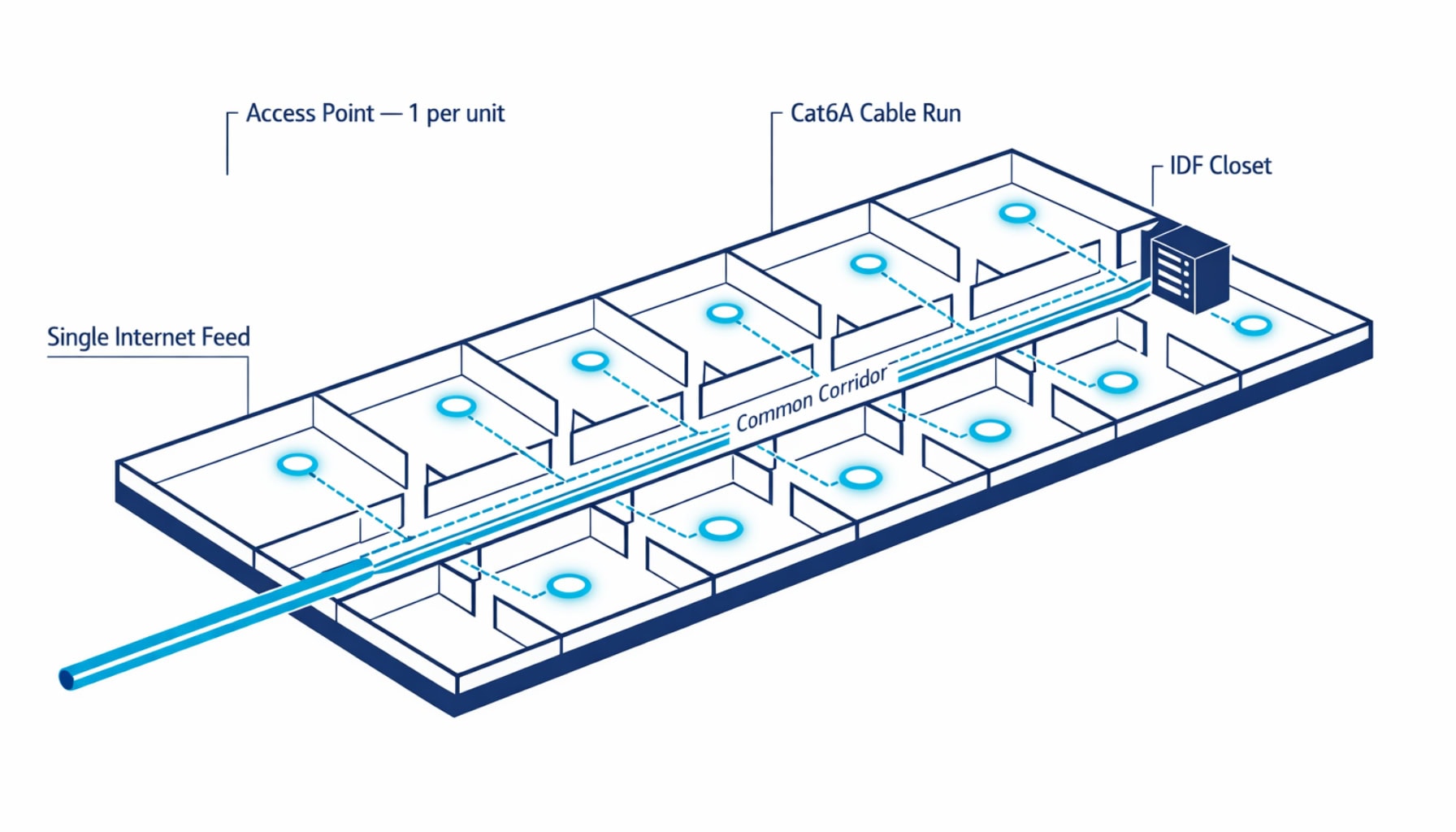
Managed Wi-Fi rough-in diagram showing access point placement, Cat6A cable runs, and IDF Closet layout for a multifamily building floor plate
Standard Requirements Summary Per Unit
Cabling Type Cat6A or Cat6 Run to each unit
Device Location 1 per unit, ceiling Unit center preferred
Power Source Powered over cable No in-unit outlet needed
Equipment Closet Per floor or zone Min 4ft x 4ft, conditioned
Common Areas Additional devices Amenity and lobby coverage
Internet Entry Single point of entry Skyrise Wi-Fi selects and manages
What Ownership Receives

What Ownership Receives at Handoff: Standard Build vs. Managed Wi-Fi

What you deliver at turnover determines what ownership can build from. A commissioned Managed Wi-Fi system changes the starting position of every future operator, investor, and buyer.

Traditional Handoff
Standard Multifamily Development
No internet revenue line on the rent roll
Residents individually contract with outside ISPs
Fragmented equipment from multiple providers in closets
No centralized network management or monitoring
On-site staff field internet complaints with no authority to resolve them
Retrofitting required to add a managed system post-occupancy
No internet infrastructure asset to underwrite at disposition
Skyrise Wi-Fi Handoff
Property-Owned Managed Wi-Fi System
Internet revenue active from first lease. Structured as a technology fee on every unit.
Property owns the network. No ISP owns the resident relationship.
Single standardized system. Clean closets. One operating partner.
Skyrise Wi-Fi monitors and manages the system continuously. Zero on-site IT involvement required.
All resident support handled directly by Skyrise Wi-Fi. Staff involvement is by design zero.
Infrastructure built into the project. No retrofit cost or construction disruption.
Documented revenue-producing building asset generating $52/unit net. Supports NOI underwriting at sale or refi and capitalizes at disposition.
The Pro Forma Case

Internet Infrastructure Is a Financial Decision, Not Just a Design One

Every Class A building delivers amenities. The ones built with a property-owned network deliver a revenue line. The difference shows up in the pro forma at lease-up and at every disposition or refinancing event after that.

$52
Net Revenue Per Unit Per Month
Average net after bandwidth and operating costs. Structured as a technology fee on every occupied unit.
$187K+
Annual NOI Added at 300 Units
New recurring revenue line with no prior equivalent. Starts from the first lease and compounds through the hold period.
$3.4M+
Asset Value Lift at a 5.5% Cap Rate
NOI increase capitalized at sale or refinancing. The internet system is no longer invisible at transaction.
Why It Matters at the Development Stage

Build It In Now. Capture the Value at Every Stage.

The decision to include a property-owned Managed Wi-Fi system is made during design. So is the decision not to. A building handed off without internet infrastructure delivers ownership a gap on the rent roll from day one.

When internet is built into the project, ownership receives a documented, revenue-producing asset at turnover. The technology fee appears on the rent roll. It is capitalized at sale. It is defensible in underwriting. It does not require a retrofit to realize.

For a 300-unit development generating $52 per unit per month in net internet revenue, that is $187,200 in annual NOI before the first lease renewal. At a 5.5% cap rate, that NOI contribution adds approximately $3.4 million in asset value at disposition.

Model your project in the NOI Calculator
$7.8K Per Month
150-Unit Development
$93,600 annual NOI contribution. Asset value lift of approximately $1.7M at a 5.5% cap rate.
$10.4K Per Month
200-Unit Development
$124,800 annual NOI contribution. Asset value lift of approximately $2.3M at a 5.5% cap rate.
$15.6K Per Month
300-Unit Development
$187,200 annual NOI contribution. Asset value lift of approximately $3.4M at a 5.5% cap rate.
$20.8K Per Month
400-Unit Development
$249,600 annual NOI contribution. Asset value lift of approximately $4.5M at a 5.5% cap rate.

*Representative figures based on $52/unit/month net revenue. Asset value calculated at a 5.5% cap rate for illustrative purposes. Actual results vary by market, occupancy, and property-specific conditions.

Resident Experience

Day One Connectivity. No Setup. No Waiting.

The resident experience is a product of the infrastructure decision made during design. A property-owned network means residents connect on move-in day, not after a technician appointment and a two-week activation window.

// 01

No Provider Shopping Required

Internet is included as part of the lease. Residents do not contact ISPs, schedule installs, or wait for activation. The network is live in every unit on move-in day.

Day 1 Connectivity at move-in
// 02

Building-Wide Coverage

Access points in every unit and across all common areas. Residents get a private, secure network that works in their apartment, the fitness center, the lobby, and the rooftop deck.

100% Property coverage at commissioning
// 03

Centralized Support. Zero On-Site Burden.

When a resident has an internet issue, they contact Skyrise Wi-Fi directly. On-site staff are not in the loop. There is no ISP dispatch to coordinate, no equipment to troubleshoot, and no resident complaint queue for your team.

Zero On-site staff involvement required
Future-Ready Infrastructure

Smart Building Infrastructure for Multifamily Developers

The network is the building's technology backbone. Every smart building system that follows — access control, CCTV, IoT sensors, smart units, package management — runs on the same infrastructure. Designing it at the project phase means these capabilities are available from day one and expandable at any point during the hold period without retroactive cabling or additional closet infrastructure.

For developers building to sell, this is a documented technology platform that transfers to ownership. For long-term holds, it is the foundation every future operational system plugs into.

Access Control CCTV Smart Locks Package Systems IoT Sensors EV Charging
Explore Smart Building systems

Access Control

IP-based door and entry systems run directly on the building network. No separate cabling required.

CCTV and Security

IP cameras integrated on the managed network. Centralized recording and monitoring without additional infrastructure.

Smart Unit Systems

Smart thermostats, locks, and lighting all network-enabled without additional wiring during construction.

Package and Logistics

Smart package rooms and locker systems connect directly to the property network. No secondary install coordination needed.

Developer Questions

Managed Wi-Fi for Multifamily Developers: Common Questions

These are the questions development teams raise during pre-construction, design review, and underwriting. Direct answers, no marketing language.

Speak with our development team
The earlier the better, but design development is the target. Pre-permit engagement allows us to include AP locations, conduit routes, and closet specifications directly in the architectural and MEP drawings. Engaging after construction begins does not disqualify a project, but it typically results in more coordination overhead and potential change orders. We are available to consult at concept phase at no obligation.
The infrastructure is funded as a capital cost of the project — the same as any other building system. The rough-in work is performed by your electrical subcontractor and included in your hard cost budget. Skyrise Wi-Fi provides the network equipment, installation, commissioning, and ongoing management. The system becomes a permanent asset that transfers to ownership at handoff. There is no free installation model.
The rough-in requirements are consistent with standard multifamily construction. Cat6A runs to each unit and common area, conduit to IDF closets, and a single ISP entry point. The incremental cost relative to a building wired for individual ISP connections is typically modest. Skyrise Wi-Fi provides a line-item estimate during pre-construction engagement so your team can include it in the initial budget model. The long-term NOI contribution to ownership substantially offsets the capital cost in underwriting.
On new construction, there are typically no existing ISP agreements to work around. Skyrise Wi-Fi selects and manages the upstream ISP relationship as part of the service. Where regulations require competitive provider access, Skyrise Wi-Fi coordinates compliance. The goal is a single, clean entry point managed by the property rather than a building where multiple providers have independent infrastructure.
Yes. Phased projects are planned at the portfolio level so infrastructure decisions in Phase 1 are compatible with and connected to Phase 2 and beyond. Multi-building campus deployments benefit from a single network management platform, consolidated ISP agreements, and consistent resident experience across the full asset. We engage at the master plan level for large-scale developments.
The system is commissioned and operational before the certificate of occupancy. At handoff, ownership receives a fully documented, revenue-ready network. Skyrise Wi-Fi transitions from development partner to long-term operating partner. The management agreement and technology fee structure are in place before the first resident moves in. Ownership inherits a revenue line, not a buildout project.
Get Started

Start with a Pre-Construction Consultation

Share your project at any stage and we will review the plans, outline what the building needs, and provide an initial estimate for your budget model. No obligation.

Initial Recommendation Within One Business Day
A preliminary infrastructure outline based on your project size, layout, and development stage.
Budget-Ready Cost Estimate
Initial cost estimate formatted for your hard cost and pro forma model. Detailed scope follows at plan review.
Available for Plan Review Calls
We will join a call with your architect or engineer at any stage of design to answer scope and coordination questions.

No obligation. Consultation delivered within one business day.
By submitting this form, you agree to be contacted by Skyrise Wi-Fi. We respect your privacy and will not share your information.